
Don’t Let Tooth Loss Weaken Your Jaw!
Losing a tooth is about more than just a gap in your smile. It affects how you eat, speak, and feel about yourself. But many people don’t realize that a missing tooth also starts a hidden problem beneath the surface: the slow weakening of your jawbone.
Without the right replacement from your dentist, this bone loss can cause bigger dental issues and change the shape of your face. Thankfully, restorative dentistry offers a permanent solution that does much more than just fill a space. Dental implants are the only tooth replacement option that can actually protect and preserve your jawbone for a lifetime.
Let’s talk about why your jawbone is so important and how dental implants work to keep it strong and healthy.
How Implants Protect Your Smile
Why Your Jawbone Needs Your Teeth
Think of your natural tooth as an iceberg. The part you see is just the top. The real foundation is the root, which extends deep into your jawbone.
Every time you bite or chew, you create tiny, healthy pressures that travel down the tooth root into the bone. This stimulation acts like exercise for your jaw. It sends a signal to your body to keep the bone in that area dense, strong, and full of nutrients.
When a tooth is lost, that root is gone. The section of jawbone where it used to be no longer gets that essential exercise. Without stimulation, your body thinks the bone is no longer needed. It begins to slowly resorb, or dissolve away. This process does not stop on its own and will continue as long as the tooth is missing.
Over time, this bone loss can cause serious problems:
- Facial Changes: Loss of jawbone can make the lower part of your face look collapsed or sunken in. It can make you look older than you are.
- Shifting Teeth: Your remaining teeth can start to drift into the empty space, becoming crooked and harder to clean.
- Future Dental Problems: This shifting and bone loss can make future tooth replacement more difficult and can even put your other healthy teeth at risk.
How a Dental Implant Acts Like a New Root
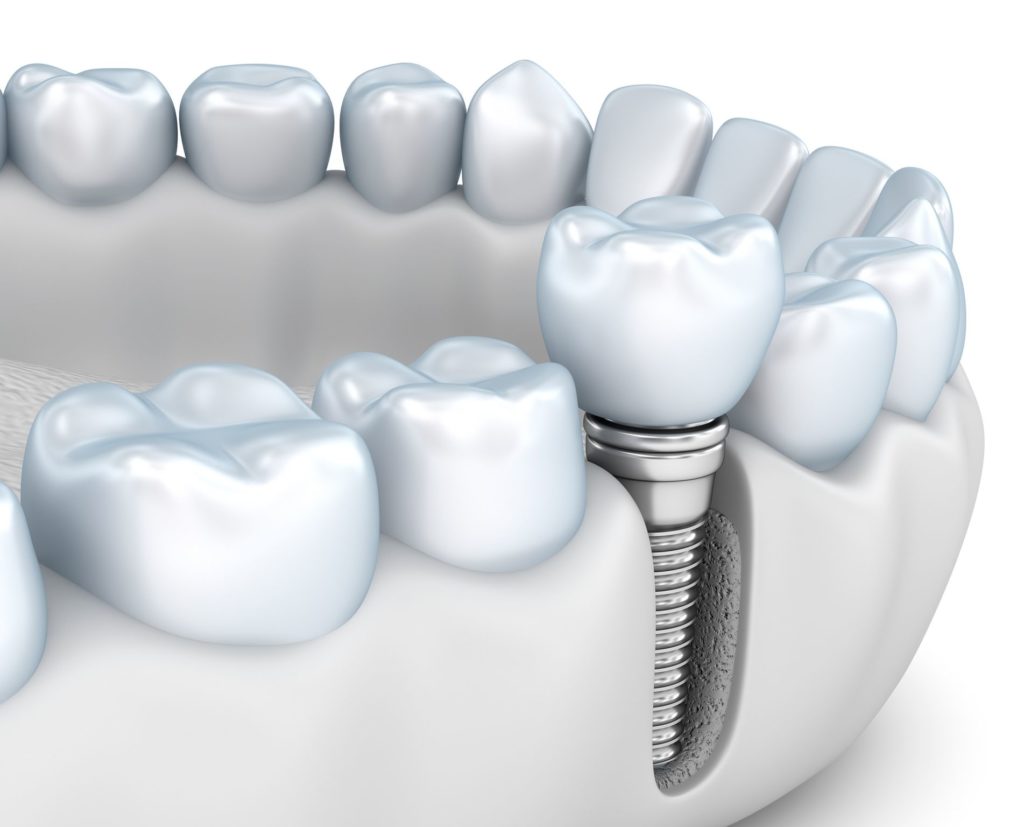
A dental implant is a small, incredibly strong titanium post that a dentist carefully places into your jawbone. It’s not just a replacement tooth. It’s a replacement tooth root. After it’s placed, a process called osseointegration occurs. This is a fancy word meaning the implant fuses directly with your living jawbone, becoming a permanent part of your body.
Once healed, an abutment (connector) is attached to the implant, and finally, a custom-made crown is placed on top. The result looks, feels, and functions just like a natural tooth.
Here is the key part for your jaw: because the implant is anchored in the bone, every time you bite down, you stimulate the jaw again. Just like with a natural root, this “exercise” tells your body to maintain the bone in that area. It stops the process of deterioration.
In some cases, an implant can even help encourage some lost bone to regenerate. No other replacement option can do this. Dentures and bridges sit on top of the gums. They do nothing to prevent the bone underneath from slowly shrinking away.
What If My Jawbone Is Already Weak?
This is a very common and important question. To support an implant, you need to have enough healthy, dense jawbone to hold it securely.
The good news is that your dentist can easily check this. During a consultation, they will use X-rays or a 3D scan to look at the shape and density of your jawbone. If some bone has been lost, it does not automatically mean you cannot get an implant.
For many patients, a simple procedure called a bone graft can solve the problem. In this treatment, your dentist adds a special grafting material to the weakened area of your jaw. This material acts as a scaffold that encourages your own body to grow new, strong bone around it. After several months of healing, the site is often ready to successfully support an implant.
If a bone graft is not the right option for you, your dentist will discuss other excellent tooth replacement solutions, like bridges or dentures. The goal is to find the very best way to restore your smile and your ability to chew comfortably.
The Lasting Benefit of a Strong Foundation
Choosing a dental implant is an investment in your long-term oral health. It’s the only solution that tackles the entire problem of tooth loss, both above and below the gumline. By preserving your jawbone, an implant helps maintain the natural shape of your face, protects your other teeth, and provides a stable, permanent foundation for your new smile.
Learn more about our dental implant services:
- All-On-Four Dental Implant Concept
- Benefits of Dental Implants
- Cost of Dental Implants
- Dental Implant FAQs
- Dental Implants vs. Dentures
- Single Dental Implants
- The Dental Implant Process
If you are considering options to replace a missing tooth, ask Dr Goyal at Columbia Family Dentist about the health of your jawbone and how an implant could protect it. Taking this step now can save you from more complex issues in the future.