
You have one tooth you can’t stand. Is it chipped, discolored from an old injury, slightly rotated, or shaped differently from the others? Every time you look in the mirror, your eye goes straight to it.
Now you’re wondering whether you can just get a porcelain veneer on that one tooth and be done with it. The answer isn’t so straightforward, and it depends on things you can’t see in the mirror.
Why One Tooth Is Different
When you replace all your front teeth with veneers, you control the shade, shape, and texture. Everything matches because everything is new.
When you replace one tooth, you’re trying to match a single piece of porcelain to the natural teeth around it. That’s a much harder problem, and it’s where many single-veneer cases go wrong.
Natural teeth aren’t uniform. They vary subtly in color, translucency, and surface texture. The tooth next to the one you want to fix might be slightly warmer in tone, or have a small white spot, or reflect light differently. If the new veneer matches a shade guide perfectly but doesn’t match the neighboring teeth’s specific characteristics, it’ll stand out.
That’s the opposite of what you want. You’re getting a veneer because you want the tooth to blend in. If it doesn’t blend, you’ve spent money to create a new problem.
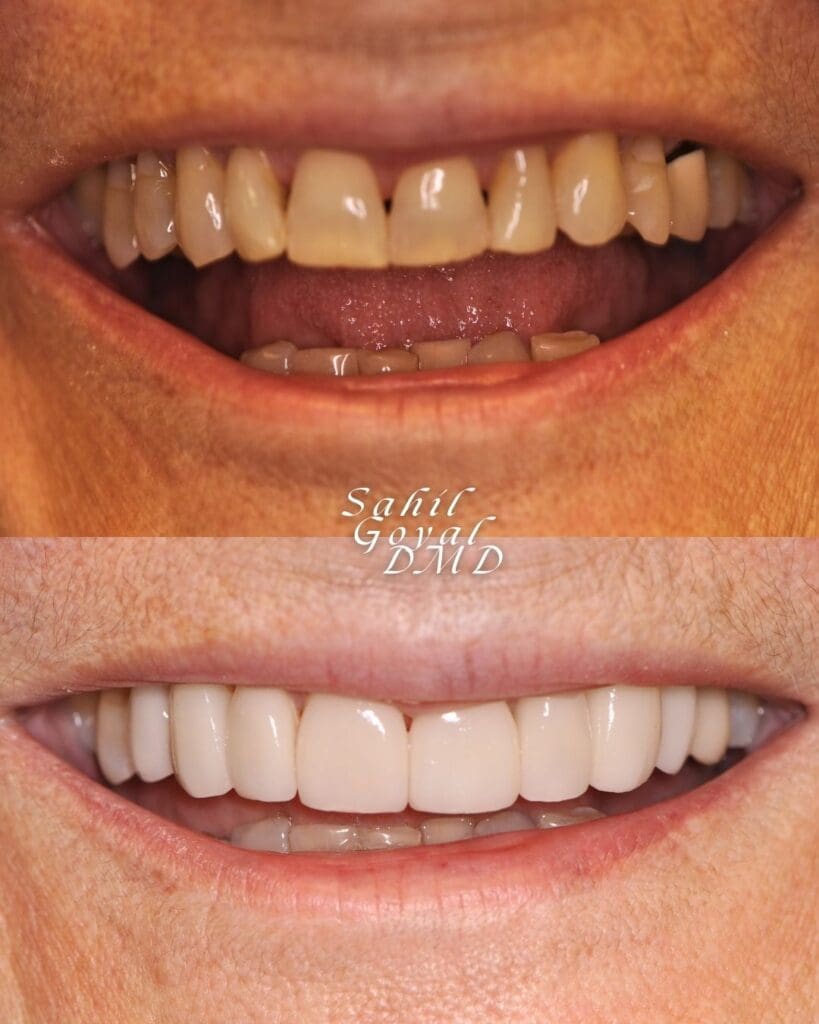
When a Single Veneer Works Well
A single veneer can be a great solution in certain situations, including:
- The tooth is chipped or broken. A single veneer can restore the tooth’s shape and appearance without affecting its neighbors. This works best if the damage is confined to the front surface and the surrounding teeth are healthy.
- The tooth is discolored, and whitening hasn’t worked. Some stains, especially those from old trauma or certain medications, don’t respond to whitening. A veneer can cover the discoloration while matching the surrounding teeth.
- The tooth is slightly rotated or misshapen. A veneer can change the tooth’s apparent shape without orthodontics, as long as the bite is healthy.
- The adjacent teeth are similar in shade and texture. If the teeth on either side of the problem tooth are relatively uniform, matching a single veneer is more achievable.
- You’re willing to accept some compromise. Even in the best case, a single veneer won’t be a perfect match. It’ll be very close, but a trained eye might notice a subtle difference. If that works for you, a single veneer can work well.
When a Single Veneer Creates a Bigger Problem
A single veneer won’t work in these situations:
- If the adjacent teeth are varied. If the teeth around the problem tooth have different shades, textures, or small imperfections, matching one veneer to all of them is nearly impossible. You’ll end up with a veneer that looks slightly off no matter what you do.
- The problem tooth is significantly different in color. If the tooth you want to fix is much darker or lighter than its neighbors, a single veneer can’t bridge that gap without looking artificial. In these cases, whitening the surrounding teeth first, or using a small set of veneers, often produces a better result.
- Your bite is uneven. If a tooth takes more force than it should, a veneer on that tooth may chip or fail. Address the bite first.
- Your gums are uneven. If the gumline around the problem tooth is different from the surrounding teeth, a veneer alone won’t fix the asymmetry. Gum contouring may be needed.
- You’re a perfectionist. Some patients are never happy with a single veneer because they can always see the difference. If you’re that person, a small set (four or six veneers) can produce a result you’re happier with because the whole smile is coordinated.
The Honest Conversation
At Veritas Dental Institute, we have this conversation with patients regularly. Dr. Anshu Goyal’s cosmetic focus and meticulous attention to detail mean she explains why a single veneer might not be the best choice, even when the patient came in wanting exactly that.
That’s an honest recommendation based on what will actually look good. Sometimes a single veneer is the right answer. Sometimes it’s four veneers, or it’s whitening plus a single veneer. In other cases, dental bonding is better than a veneer because it’s less expensive and can fit minor cosmetic issues. Learn more about our Cosmetic Dentistry here.
Dr. Sahil Goyal’s restorative background matters here too. A veneer isn’t just a cosmetic add-on. It’s a restoration that must work with your bite. If the tooth takes uneven force, or if the veneer would interfere with how your teeth meet, we need to address that before any cosmetic work begins.
What the Consultation Includes
At our Columbia dental practice, the cosmetic consultation is complimentary. It includes a full exam, digital scans, and a conversation about your goals. We’ll show you what a single veneer and a small set would look like. Then we’ll give you an honest recommendation.
We’ll also talk about cost. We don’t publish specific prices because cost depends on the number of veneers, the case’s complexity, and whether you need other treatment first. Our dentists will give you a complete, itemized treatment plan so you know exactly what you’re paying for.
We offer CareCredit and other financing options, including Proceed Finance, Cherry, Lending Club, and Sunbit. Many patients qualify for interest-free financing. We also accept most major PPO dental insurance plans, and we’ll verify your benefits before you arrive.
The Question to Ask Yourself
Before you book a consultation, ask yourself: if a single veneer would look good but not perfect, would you be happy? Or would you rather spend a bit more for a small set that looks completely coordinated?
There’s no wrong answer. Some patients want the minimal intervention, and that’s valid. Others want the whole smile to match, and that’s valid too. The important part is to go into the consultation knowing what matters to you, so we can tailor our recommendation to your priorities.
What to Do Next
If you’re in Columbia, Ellicott City, Laurel, Fulton, or anywhere in Howard County and you’re thinking about a single veneer, the next step is a consultation. Our office is at 9650 Santiago Road, Suite 104.
Call Verita Dental Institute at 410-670-8211 or request an appointment online. We’ll review your smile, show you your options, and give you an honest answer about what will actually work.